Featured Paper
Advice about science and life from an Institute Project Leader Hikari Yoshitane, Circadian Clock Project
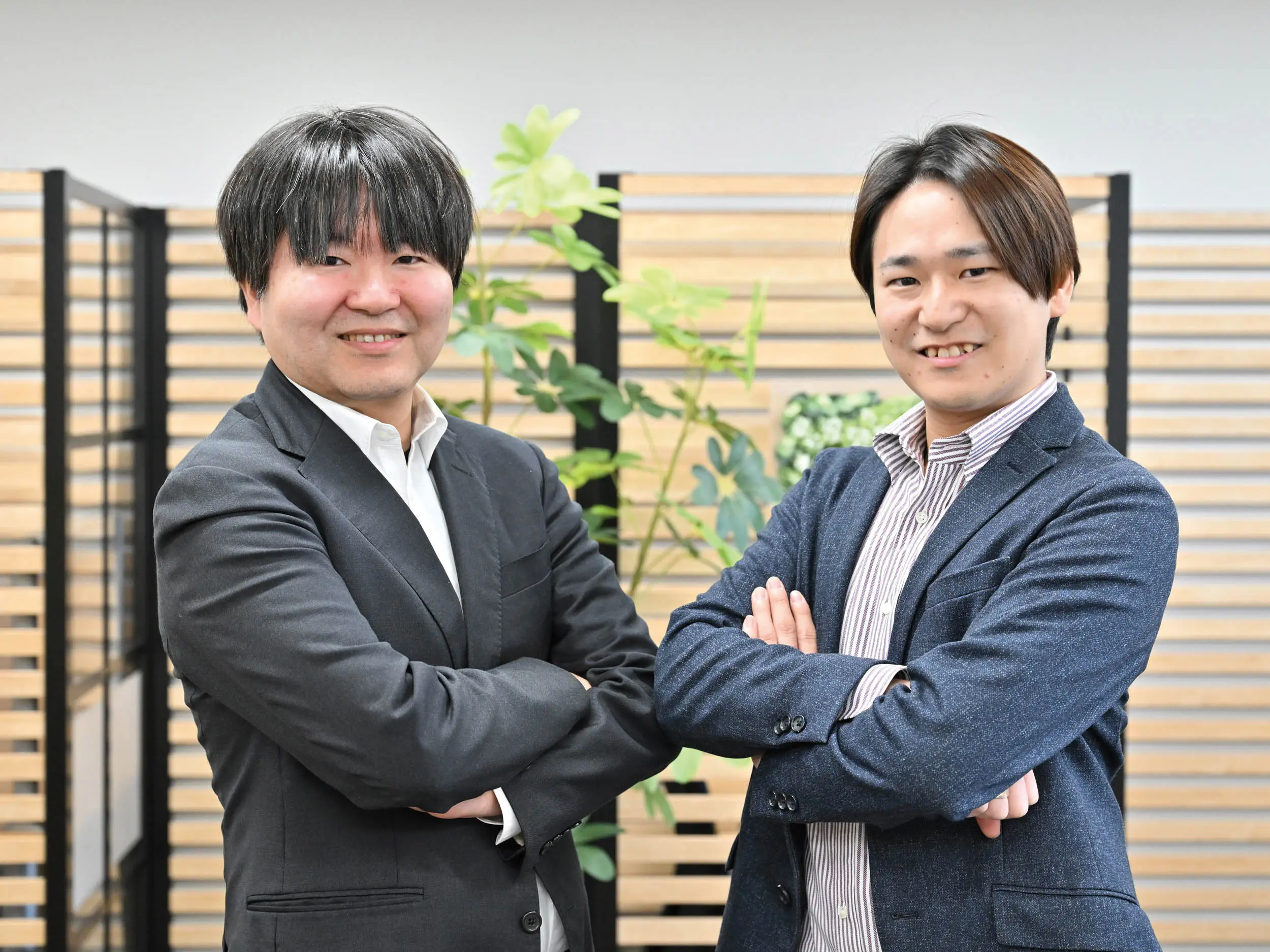
and
Dr.Yuta Otobe (right)
and
Dr.Yuta Otobe (right)
You can’t do research half-heartedly. You have to find the right question, the right theme that interests you.
The mammalian circadian clock is an amazing machine. When we study biochemistry in college, we learn that biological reactions tend to approach a state of equilibrium where reactants and products exist in a steady state. However, biological clocks don’t follow this basic rule. Instead, they oscillate back and forth around the equilibrium without staying there. Harmonic oscillations have been explained in physics, but the basic principles underlying biological clocks are still unknown. Progress has been made, and negative feedback pathways involving key clock components have been identified. However, these findings still don’t explain why biological clocks don’t maintain a steady-state equilibrium. Dr. Hikari Yoshitane’s goal is to understand how circadian clocks work.
Recently, Dr. Yoshitane and colleagues published a remarkable paper in Molecular Cell, entitled “A mouse circadian proteome atlas.” It doesn’t identify the core mechanism of clock function (he plans to publish findings in that area next year in an even higher-impact paper), but instead, it was a characterization the circadian activity of almost 19,000 proteins, covering approximately 74% of all mouse proteins. In this paper, Dr. Yoshitane and colleagues dissected 32 tissues from mice at 4-hr time points throughout a 24-hr day and analyzed proteins from these tissues using mass spectrometry. They identified proteins that show variations in amounts throughout a circadian day in different tissues, proteins that showed circadian variations in nuclear localization, and proteins that showed circadian variations in phosphorylation, which regulates activity. Overall, they found that more than half of all proteins exhibit rhythmic activity in various tissues, and they created an online resource that allows scientists to observe the circadian profiles of all the proteins they analyzed. We spoke to him about this work.
What interests you about circadian rhythms?
I’m interested in the basic question of how genes and proteins make an accurate clock. But I’m also fascinated by a particular aspect of the clock: its temperature independence. All biological reactions are highly dependent on temperature. They have a temperature where they work optimally, but if that temperature is raised or lowered even slightly, the reaction speed drops precipitously. That doesn’t happen with the biological clock. Its rhythm stays constant. If you think about that a little, it’s very curious. How do you build a clock or a machine that is temperature independent from components or reactions that are all highly temperature dependent? It’s a mystery that I’m fascinated by.
What is it that you like most about research?
I’m most thrilled at the moment when an idea strikes. There are so many questions in the world that are fascinating, but just not answerable right now. And then there are many questions that you can find the answers to, but the questions aren’t particularly interesting. And finally, there are some questions that are fascinating that you can find the answers to if you are just creative and inspired enough. When I come up with an experiment that will clearly answer a question like that, that’s fun. That’s the part I enjoy most about research.
What was the motivation for your current paper?
My main interest is to identify the mechanism of the 24 hr circadian clock. But as a scientist who studies the clock, a question that comes up is: What is the purpose of the clock? And the answer is to organize the body’s physiological functions. To regulate the rhythms of the whole body. Different biological functions need to occur at different times of the day. Some are needed at midday, some in the evenings, some at night. That’s why the biological clock is important: it regulates the timing of biological functions. So, in order to understand the body’s physiology, we need to know the daily activity profiles of various proteins. Recently, we’d obtained an amazing next-generation mass spectrometer that allowed us to analyze about 10,000 proteins at once. So, this paper resulted from the intersection of opportunity, ideas, technological ability, and effort. We realized that we could analyze the circadian profiles of massive numbers of proteins from different tissues, and publish a paper and make an online resource that would be enormously useful for chronobiologists, physiologists, and other scientists.
That must have been a tremendous amount of work.
I have to credit the first author, Yuta Otobe, who was pretty amazing. At first, I thought we could analyze circadian profiles in four or eight commonly studied organs for our study, but we realized that competitors and groups from other countries may also be doing similar work, and we wanted to produce a resource that would be useful for a long time. To do this, we needed to obtain high-quality, reliable data, analyze many proteins, and publish first. Otobe kun, from early on, was eager to expand the number of proteins we analyzed, so the number of tissues we analyzed went from four or eight to thirty-two. To encourage each other, we used to joke that we were aiming for the Guinness World Record for the most proteins analyzed. Our ultimate dream would be to characterize all proteins so that scientists wouldn’t have to analyze individual proteins using Western blots ever again. They could just look up the data on our site.
We also realized that to create an online resource that people would use, we needed a simple user interface to make our data more accessible. We couldn’t simply post raw mass spectrometer data or even data organized into Excel files. In the end, we worked with a professional website company to create a user-friendly interface that allows users to quickly search for proteins and displays protein amounts graphically. Even then, it took over nine months to work out all the bugs and get a working server running. Overall, I think it was worth it. If we didn’t have a usable site running or if we only posted raw data, few people would access our data.
What impact has this paper had?
When we presented our work at conferences, our presentations were packed, and we received lots of offers for collaborations to see our data before publication. My lab is also gaining recognition for our ability to do large-scale protein analyses and our expertise in circadian biology from this work, so I’ve had lots of offers for collaborative work on that front as well. Personally, I’m also predicting that our work will have an impact on medicine. Medicines have different effects on patients depending on the time of day they are taken, but we don’t really know why, and most knowledge about when a particular medicine is most effective is based on patient feedback. I think that if we analyze the rhythms of all the proteins affected by a drug, we will be able to determine when a drug will be most effective. Similarly, if we can analyze the proteins that drugs interact with that cause side effects, we should be able to determine when a drug is safest to take and when we need to be more cautious. I think patients and doctors will benefit from a comprehensive list of drugs and the optimal times to take them.
What are your plans for the future of this project?
Analyzing protein amounts is useful, but protein amounts on their own aren’t enough to determine protein activity. For example, we showed that the nuclear localization of proteins may fluctuate in a circadian manner although the total protein amounts may remain the same. And even if the nuclear amounts of a protein are stable, the phosphorylation and activation of the protein may be rhythmic. So, to get an even more accurate idea of protein behavior and activity during a circadian day, we are planning to separate proteins into subcellular compartments before analyzing them by mass spectrometry. We’re planning on separating tissue extracts into cytoplasmic, mitochondrial, lysosomal, Golgi, and endoplasmic reticulum fractions to analyze. In the brain, we’re planning to separate different neuronal and glial cell types as well as separate cell body proteins from synaptic proteins. From this work, we should obtain a more comprehensive model for when and where individual proteins are made, transported, and active during the circadian day.
What is your advice to young people interested in research?
Find a theme or question that you can devote your life to pursuing. You can’t do research half-heartedly. You have to find the right question, the right theme that interests you. I come from a generation when family computers and computer games were just becoming popular, and I was addicted to them as a child. I always wanted to know what comes next, what appears on the next level. I feel that way about research now. I work late nights and weekends because I’m excited by it. I want to continue the story and find out what comes next. As a scientist, you will be working with and competing against other people who have that passion, and you won’t be able to keep up or excel unless you have the same or greater passion. So, immerse yourself and have fun!
Interviewed by Jun Horiuch